Contextual Studies - 9th January Onwards
This week we moved on to look more into the world of Photography and how photographers were wanting to create a new photographic esthetic, we did this by first looking at Rodchenko.
Rodchenko -
He was a designer and photographer. He was a Russian artist, sculptor, photographer and graphic designer. He was one of the founders of constructivismand Russian design.
Rodchenko was one of the most versatile Constructivist and Productivist artists to emerge after the Russian Revolution. He worked as a painter and graphic designer before turning to photomontage and photography. His photography was socially engaged, formally innovative, and opposed to a painterly aesthetic. Concerned with the need for analytical-documentary photo series, he often shot his subjects from odd angles—usually high above or below—to shock the viewer and to postpone recognition.
http://en.wikipedia.org/wiki/Alexander_Rodchenko
Here below are some of his images that he produced -


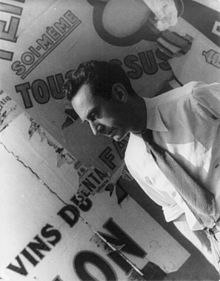





He was a designer and photographer. He was a Russian artist, sculptor, photographer and graphic designer. He was one of the founders of constructivismand Russian design.
Rodchenko was one of the most versatile Constructivist and Productivist artists to emerge after the Russian Revolution. He worked as a painter and graphic designer before turning to photomontage and photography. His photography was socially engaged, formally innovative, and opposed to a painterly aesthetic. Concerned with the need for analytical-documentary photo series, he often shot his subjects from odd angles—usually high above or below—to shock the viewer and to postpone recognition.
http://en.wikipedia.org/wiki/Alexander_Rodchenko
Here below are some of his images that he produced -
After researching the work Rodchenko and looking at his images, i have come to like his images and what they are about. I think photographers can learnt from Rodchenko because of the way he took images - taking images at different (not the normal) angles. I like how he used different angles because it makes you look and think about his images more because you are trying to figure out what they are actually of. I think i am bit like Rodchenko in this way because i too like taking photos on a angle instead of just from front on.
In our days now people always believe a photograph rather then someones word, this is because of photoshop and software like that, now our days with images your can change them how you want to look, where as with Rodchenko's images they were and are purely photographic images - nothing has been changed within them, they just make you think because of the able they have been so cleverly taken on.
Next we moved on to talk about Moholy Nagy.
Nagy was born in July 20, 1895 – November 24, 1946) and was a Hungarian painter and photographer as well as professor in theBauhaus school. He was highly influenced by constructivism and a strong advocate of the integration of technology and industry into the arts.
Here are some images of the work that he produced -
Nagy's work was a direct response to commission. They wanted a new way at looking at the world.
Moholy-Nagy made his way in London by taking on various design jobs includingImperial Airways and a shop display for men's underwear. He photographed contemporary architecture for the Architectural Review where the assistant editor was John Betjemanwho commissioned Moholy-Nagy to make documentary photographs to illustrate his book An Oxford University Chest. In 1936, he was commissioned by fellow Hungarian film producer Alexander Korda to design special effects for Things to Come. Working at Denham Studios, Moholy-Nagy created kinetic sculptures and abstract light effects, but they were rejected by the film's director. At the invitation of Leslie Martin, he gave a lecture to the architecture school of Hull University.
Next we went on to research and talk about Man Ray.
Man Ray was born in August 27, 1890 – November 18, 1976), born Emmanuel Radnitzky, was an American artist who spent most of his career in Paris, France. Perhaps best described simply as a modernist, he was a significant contributor to both the Dada and Surrealistmovements, although his ties to each were informal. Best known in the art world for his avant-garde photography, Man Ray produced major works in a variety of media and considered himself a painter above all. He was also a renowned fashion and portraitphotographer. He is noted for his photograms, which he renamed "Rayographs" after himself.
Man Ray started to make Photograms - this is directly placing objects on to the photographic paper and exposing it to light. This is an example of a photogram -
Then they later developed this by using Solorization - this is using a negative effect in the images - here are some example to show this -
They did these many different thing to their images because they saw photography as more of an art form.
I dont really like Man Ray's work because i prefer proper photographs rather then photograms and all the other effectives like solorization that they used.
Next we discussed Atget.
Eugène Atget (February 12, 1857 – August 4, 1927) was a French photographer noted for his photographs documenting the architecture and street scenes of Paris.
By the mid-1890s, Atget bought his first camera and began to photograph more than 10,000 images of the people and sights of Paris.
Atget photographed Paris with a large-format wooden bellows camera with a rapid rectilinear lens. The images were exposed and developed as 18x24cm glass dry plates.
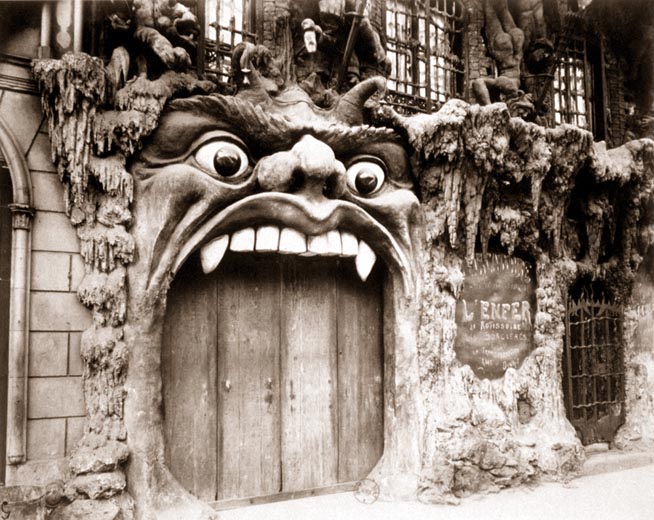
Between 1897 and 1927 Atget captured the old Paris in his pictures. His photographs show the city in its various facets: narrow lanes and courtyards in the historic city center with its old buildings, of which some were soon to be demolished, magnificent palaces from the period before the French Revolution, bridges and quays on the banks of the Seine, and shops with their window displays. He photographed stairwells and architectural details on the façades and took pictures of the interiors of apartments. His interest also extended to the environs of Paris.
In addition to architecture and the urban environment, he also photographed street-hawkers, small tradesmen, rag collectors and prostitutes, as well as fairs and popular amusements in the various districts. The outlying districts and peripheral areas, in which the poor and homeless sought shelter, also furnished him with pictorial subjects.
Here are example of the work that he took -
I liked looking at Atget's work, but that all, i don't think i would ever try and produced work like he did. His work has a lot of character in it. Atget went around Paris photographing it and what it looked then, so basically he was documenting the place.This is a good idea because now years later people like me can see what paris looked like even though i wasn't there to see it first hand.
next we looked at Henri-Cartier-Bresson.
Henri Cartier-Bresson (August 22, 1908 – August 3, 2004) was a French photographer considered to be the father of modernphotojournalism. He was an early adopter of 35 mm format, and the master of candid photography. He helped develop the "street photography" or "real life reportage" style that has influenced generations of photographers who followed.
Bresson is also know as one of the best photographers of all time and also the person who brought about "The Decisive Moment". The Decisive Moment is the one moment where everything within that soon to be image fits - capturing life as he put it.
I love Bressons work, every picture is completely different to the first. I also like his work because i don't think any photographer that ha come after Henri Cartier Bresson has been able to show the decisive moment in their images quite like him. Every image leaves you wanting to see more and more.
Next is Robert Capa.
He was born Endre Ernő Friedmann; October 22, 1913 – May 25, 1954) was a Hungarian combat photographerand photojournalist who covered five different wars: the Spanish Civil War, the Second Sino-Japanese War, World War IIacross Europe, the 1948 Arab-Israeli War, and the First Indochina War. He documented the course of World War II inLondon, North Africa, Italy, the Battle of Normandy on Omaha Beach and the liberation of Paris. His action photographs, such as those taken during the 1944 Normandy invasion, portray the violence of war with unique impact. In 1947, Capa co-founded Magnum Photos with, among others, the French photographer Henri Cartier-Bresson. The organization was the firstcooperative agency for worldwide freelance photographers.
Normandy - was the only photographer there and by him being there he produced the first photographs of war.Also in film "Saving Private Ryan" the opening sense was based on on the images that capa took while at war.
Next to look at was Kevin Carter.
Carter was born 3 September 1960 in Johannesburg – 27 July 1994) was an award-winning South African photojournalist and member of the Bang-Bang Club.
In March 1993, while on a trip to Sudan, Carter was preparing to photograph a starving toddler trying to reach a feeding center when a vulture landed nearby. Carter reported to have taken the picture, because it was his "job title", and leaving. He came under criticism for failing to help the girl:
- The St. Petersburg Times in Florida said this of Carter: "The man adjusting his lens to take just the right frame of her suffering, might just as well be a predator, another vulture on the scene."
Sold to the New York Times, the photograph first appeared on March 26, 1993. Hundreds of people contacted the newspaper to ask the fate of the girl. The paper reported that it was unknown whether she had managed to reach the feeding center. In 1994, the photograph won the Pulitzer Prize for Feature Photography.
I don't like these images because for me they are too hard to look at without feel bad for what i have and the life i lead compared to the child within the image.
Next we looked at Martin Parr.
Martin Parr (born 23 May 1952) is a British documentary photographer, photojournalist and photobook collector. He is known for his photographic projects that take a critical look at aspects of modern life, in particular provincial and suburban life in England. He is a member of Magnum Photos.
Parr began work as a professional photographer and has subsequently taught photography intermittently from the mid-1970s. He was first recognised for his black-and-white photography in the north of England, Bad Weather (1982) and A Fair Day (1984), but switched to colour photography in 1984. The resulting work, Last Resort: Photographs of New Brighton, was published in 1986. Since 1994, Parr has been a member of Magnum Photos. He has had almost 50 books published, and featured in around 80 exhibitions worldwide - including an exhibition at the Barbican Arts Centre, London. In 2007, his retrospective exhibition was selected to be the main show of Month of Photography Asia in Singapore. In 2008, he was made an Honorary Doctor of Arts at Manchester Metropolitan University (MMU) in recognition for his ongoing contribution to photography and to MMU's School of Art.
Parr's approach to documentary photography is intimate, anthropological and satirical. Macro lenses, ring flash, high-saturation colour film, and since it became an easier format to work in, digital photography, all allow him to put his subjects "under the microscope" in their own environment, giving them space to expose their lives and values in ways that often involve inadvertent humour. For example, to create his book Signs of the Times: A Portrait of the Nation's Tastes. (1992), Parr entered ordinary people's homes and took pictures of the mundane aspects of his hosts' lives, combining the images with quotes from his subjects to bring viewers uncomfortably close to them. The result of Parr's technique has been said to leave viewers with ambiguous emotional reactions, unsure whether to laugh or cry.
Here are some of the images he produced to show what kind of work he did -

I like Parr's documentary work because i like to look back at images and see how people were and what the places were they were, were like back then. I also like his images because he is able to capture the people very well, The people within his image aren't posing for him, he captures them as they are.
Richard Billingham was the next photographer that we looked.
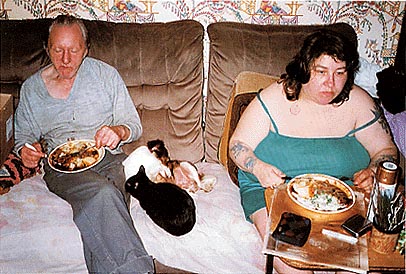
Richard Billingham was born 25 September 1970 and is an English photographer and artist who is best known for his photobook Ray's A Laugh which documents the life of his alcoholic father Ray, and obese, heavily-tattooed mother, Liz.
He came to prominence through his candid photography of his family in Cradley Heath, a body of work later added to and published in the acclaimed bookRay's A Laugh (1996). Ray's a Laugh is a portrayal of the poverty and deprivation in which he grew up. The photographs, which were taken on the cheapest film he could find, provide brash colours and bad focus which adds to the authenticity and frankness of the series. Ray, his father, and his mother Liz, appear at first glance as grotesque figures, with the alcoholic father drunk on his home brew, and the mother, an obese chain smoker with an apparent fascination for nicknacks and jigsaw puzzles.However, there is such integrity in this work that Ray and Liz ultimately shine through as troubled yet deeply human and touching personalities.
Even though Billingham works is not my favourite, i still think its an interesting body of work to look at and to research. I think this because i think its very brave to let people of the public to have a first hand insight to your life and what it was and is like.
Contextual Studies - 30th January Onwards
This week we started to look at the reasons why we do contextual studies, so to start off we name a few points.
There are a few reasons behind doing contextual studies,
- Nothing comes from nothing
- Interaction critical/contextual studies and practice - inspiration
- Acadamic study/writing enhances/communication skills/logical thought
- Comparing to other degrees
- Its interesting
- Close analysis of text
- Description of text - be obvious
- Description
- Interpretation
- Evaluation
- Importance of making links
- Anything that interests you
Writing and researching critical Studies can be anchored in close description an analysis if images, objects,films and ideas. To provide an answer for this we can use semiotics, this is signs.

As well as being simple and easy to understand like the sign i have shown above, some signs can also be complex and very powerful, an example of this is the powerful image of a black man winning the medal of honour during the American Civil war.

This is a very well known image, and if you look further into the image and try and break it down, you can see that the man within the images a very proud because of the way he is stood and because of the medal he has just won, also we can see that he is properly a bit better off because of the clothes he is wearing.
After looking, and decoding at the image of the black man in the American Cilvil War, we then went on to look at other well known image and we tried to decode them. the first image we looked at was the Vampire.

When looking at and decoding images like the vampire we identify key things which help us recognise that we looking at a Vampire, these are things like the eyes, fangs,capes, high collars.

The Vampire can stand for the supernatural, the irrational, the evil, the seductive hero.
The Vampire is also an element of enjoyment to "The Sublime", this is because we like being scared, we think and feel that it makes us feel more alive.
To help us more in trying to decode and look for more information in images and senses from films we then went on to watch 2 clips, one from "Master and Commander" and one from "The Last of the Mohicans".


After watching the clip form "Last of the Mohicans" and Master and Commander" we then went on to talk about them and to see if we could see any new information, rather than the things that we could just see from on the surface, we talked about the things we could see when we looked closer into to the story and the way it was made, we were looking for things like -signs, symbols and also looking more closely into the roles that people played within the film.
The 2 sense we watched exemplifies "The Enlightenment". The Enlightenment is also known as Taxonomy, this means systems of classification/ordering/essential to the management of knowledge.
So to summarise this lecture we we focusing in on looking past the surface and deeper into the image, signs and symbols to what it actually meant. There is also something within the image for film that had a deeper story to it and also answer to it.
Next we went on to talk about "The Enlightenment" period. The enlightenment is a name given to a period of history - the late 18th and 19th century. It stands as opposition to something like vampires and is characterised by rationality, scientific progress, taxonomy of ancient civilisations and the natural world, technological progress, exploration and imperial expansion, commerce and the industrial resolution refers to the explosion of wealth and industrial 'progress' in the same time period.
The images that we looked at to show this time period were mainly of how the fashion was back then.


Next we went on to talk about "The Enlightenment" period. The enlightenment is a name given to a period of history - the late 18th and 19th century. It stands as opposition to something like vampires and is characterised by rationality, scientific progress, taxonomy of ancient civilisations and the natural world, technological progress, exploration and imperial expansion, commerce and the industrial resolution refers to the explosion of wealth and industrial 'progress' in the same time period.
The images that we looked at to show this time period were mainly of how the fashion was back then.


Looking closely into this first image we can see that even the little children dressed like adults, looked glamorous and wealthy and also she looks like a doll, we can see that the dress would be very hard to move is, so doing any jobs was not possible.
Where as with the second image that was painted over 100 years later, we can still see the same kind of semiotic within the image. These are things like - like still look 'doll' like so still not able to many daily things because the dresses are so big, they still look wealthy and they still look glamorous too.
After this we went on to look at other images within this time period, to see how times in fashion had started to change. Here below are the 2 images we looked they are -
The impact of enlightenment on fashion, Reynolds: Ladies Waldergrave (1780) Nomney, Miss constable (1787), and Jacques Louis David: Portrait of Madame recaimer (1800), empire line dress and furniture.
By just looking at the images we can see that things have changed, the changes are thing likes - they may still be wealthy but not apart of the monarchy like in they were in the images above, also doing work would be possible now because they are not wearing extravagant clothing and lastly they look more human like and less doll like. Everything seems more relaxed in everyday life.
the last image that we looked at to do with this time period was Joseph Wright of Derby: a philosopher giving a demonstration on the orrery (1766),

In this image we can see Intellect, machine shows the function of the universe, Wealthy people, Curiosity and Light, this is showing a good idea has been created.
When looking into these images we can see many differences and similarities between them, but as time went on and as we looked at images that came later on, we can see that things started to change, the images and the people within them become more natural and laid back, things seemed more human rather than doll like.
when we first look at images you can say straight away whether you like it not, whether it is a good image for a bad image, but from learning about semiotics and looking deeper into an image and not just at the surface and then moving on i have learnt that you views can change on a image when you read more into it.
In todays lecture we moved on to looking at and talking about the work "blue poles" by Jackson Pollock.
Paul Jackson Pollock (January 28, 1912 – August 11, 1956), known as Jackson Pollock, was an influential American painter and a major figure in the abstract expressionist movement. He was well known for his uniquely defined style of drip painting.
This image doesn't really mean anything to when i look at it, and doesn't really interest me to go and look at more of his work. But if i do take the time to look at it closely and try to figure out out what the painting is of, i would say still say it wasn't of anything specifically but that the painter was maybe in a dark and unhappy place, and this is just his emotions coming out through his work.
We then went on to talk about the rosetta stone.The Rosetta Stone is an ancient Egyptian granodiorite stele inscribed with a decree issued at Memphis in 196 BCE on behalf of KingPtolemy V. The decree appears in three scripts: the upper text is Ancient Egyptian hieroglyphs, the middle portion Demotic script, and the lowest Ancient Greek. Because it presents essentially the same text in all three scripts (with some minor differences between them), it provided the key to the modern understanding of Egyptian hieroglyphs.
When moved on from talking about the rosetta stone and moved on to discuss a poet called WB Yates and Rock musician Jim Morrison.
William Butler Yeats (13 June 1865 – 28 January 1939) was an Irish poet and playwright, and one of the foremost figures of 20th century literature. A pillar of both the Irish and British literary establishments, in his later years he served as an IrishSenator for two terms. Yeats was a driving force behind the Irish Literary Revival and, along with Lady Gregory, Edward Martyn, and others, founded the Abbey Theatre, where he served as its chief during its early years.

James Douglas "Jim" Morrison (December 8, 1943 – July 3, 1971) was the lead singer and lyricist of the rock band The Doors, as well as a poet. Following The Doors' explosive rise to fame in 1967, Morrison developed a severe alcohol and drug dependency that culminated in his death at the age of 27 in Paris. He is presumed to have died from a heroin overdose, but as no autopsy was performed, the events surrounding his death and the exact cause of it continue to be disputed by many to this day.
Morrison was well known for often improvising spoken word poetry passages while the band played live. Due to his wild personality and performances, he is regarded by critics and fans as one of the most iconic, charismatic and pioneering frontmen in rock music history. Morrison was ranked number 47 on Rolling Stone's list of the "100 Greatest Singers of All Time",and number 22 onClassic Rock Magazine's "50 Greatest Singers In Rock".

I have chosen these 2 images to show because they both look puzzled yet tuned in even though where taken nearly 60 years apart. I think shows how some things dont change not matter how many years have pasted. They where both in a business that were very demanding so maybe this is what kind of result you get from someone that is over worked yet still trying to look interested.
